

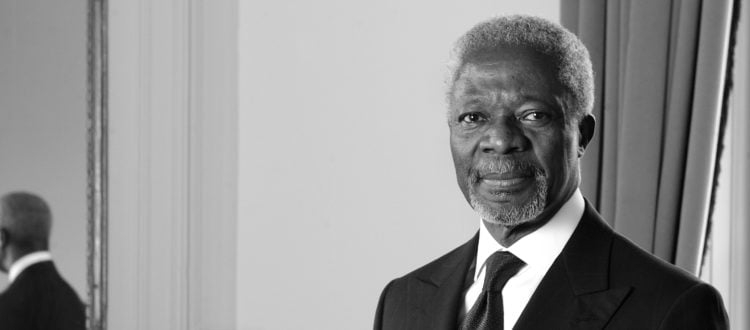
Kofi Atta Annan was one of the most distinguished statesmen and global diplomats of the 20th and 21st centuries.
As the seventh Secretary-General of the United Nations and the first to rise from within the organization’s own staff he became the most widely recognized symbol of multilateralism, human dignity, and international cooperation in his era.
The joint recipient of the 2001 Nobel Peace Prize with the United Nations, Annan served the world body for nearly five decades, shaping global policy on peacekeeping, human rights, sustainable development, and the fight against HIV/AIDS. His life and legacy represent the finest expression of what Ghana has given to the world.
Profile
| Full Name | Kofi Atta Annan |
| Born | April 8, 1938 |
| Died | August 18, 2018 (aged 80), Bern, Switzerland |
| Birthplace | Kumasi, Gold Coast (now Ghana) |
| Nationality | Ghanaian |
| Occupation | Diplomat, International Civil Servant, UN Secretary-General |
| Religion | Christian |
| Parents | Henry Reginald Annan (Father), Rose Annan (Mother) |
| Spouse | Titi Alakija (first wife, divorced); Nane Maria Lagergren (married 1984) |
| Children | Ama Annan, Kojo Annan, Nina Cronstedt (stepdaughter) |
| Net Worth | Estimated $1–2 Million USD |
Who Was Kofi Annan?
Kofi Atta Annan was a Ghanaian diplomat and international civil servant who served as the 7th Secretary-General of the United Nations from January 1, 1997, to December 31, 2006. He was the first Secretary-General to emerge from the ranks of United Nations staff, and the first from sub-Saharan Africa to hold the top position in the world’s most important multilateral institution. In 2001, he and the United Nations were jointly awarded the Nobel Peace Prize, with the Norwegian Nobel Committee praising him for bringing “new life” to the organization and for his advocacy for human rights, the rule of law, and the Millennium Development Goals. He died on August 18, 2018, in Bern, Switzerland, at the age of 80.
Early Life
Kofi Atta Annan was born on April 8, 1938, in Kumasi in the Gold Coast (now Ghana), within minutes of his twin sister, Efua Atta. His father, Henry Reginald Annan, was a hereditary paramount chief of the Fante people and the provincial governor of Asante for the Lever Brothers Company. His mother, Rose Annan, was also from the Fante and Asante aristocratic families. The grandchild and nephew of three tribal chiefs, Annan was raised in one of Ghana’s most distinguished families, with deep roots in the traditional leadership structures of the Akan people.
Growing up in Kumasi Ghana’s second-largest city and the seat of the Ashanti Kingdom Annan absorbed the values of public service, dignity, and intellectual excellence that would define his character throughout his life. He was multilingual from an early age, becoming fluent in English, French, and several Ghanaian languages. This linguistic versatility would prove invaluable in his future career as the world’s most prominent international statesman.
Education
Kofi Annan’s educational journey was remarkable for its internationalism and breadth. He attended the Mfantsipim School in Cape Coast one of Ghana’s most prestigious secondary schools, founded by Methodists in 1876, known for producing distinguished alumni in public service and the professions.
For his higher education, he enrolled at the Kumasi College of Science and Technology (now Kwame Nkrumah University of Science and Technology) in 1957. He then pursued studies at Macalester College in Saint Paul, Minnesota, USA, graduating with a degree in Economics in 1961.
Recognizing the importance of mastering the multilateral world’s working language of French, Annan enrolled at the Institut Universitaire des Hautes Études Internationales (now the Graduate Institute of International and Development Studies) in Geneva, Switzerland, where he completed a Diplôme de l’Institut in 1961. He later returned to the United States to study at the MIT Sloan School of Management, where he received a Master of Science in Management in 1972.
Career
Kofi Annan joined the United Nations system in 1962 as an administrative and budget officer with the World Health Organization (WHO) in Geneva. His UN career was extraordinary in both its duration spanning over four decades and its scope, touching virtually every major area of the organization’s work.
After Geneva, he served with the Economic Commission for Africa in Addis Ababa, the UN Emergency Force (UNEF II) in Ismailia in Egypt, the Office of the UN High Commissioner for Refugees (UNHCR) in Geneva, and in various senior administrative posts in New York dealing with human resources, budget, finance, and staff security. With the exception of a brief period from 1974 to 1976 when he served as the Director of Tourism for Ghana, he devoted his entire professional life to the United Nations.
Between 1987 and 1996, Annan served as an Assistant Secretary-General across three consecutive positions, including in Human Resources Management and Peacekeeping Operations. As Under-Secretary-General for Peacekeeping from 1993 to 1996, he oversaw the most complex and turbulent period in UN peacekeeping history, managing operations in the former Yugoslavia, Rwanda, and Somalia simultaneously. His handling of the transition of peacekeeping from UN to NATO forces in Bosnia was praised as skillful and professional, though the UN’s failure to prevent the 1994 Rwandan genocide a tragedy that occurred on his watch as peacekeeping chief haunted him for the rest of his life. He later acknowledged that he “could and should have done more” and that this painful memory profoundly influenced his leadership as Secretary-General.
On January 1, 1997, Kofi Annan was sworn in as the 7th Secretary-General of the United Nations, becoming the first from sub-Saharan Africa and the first to be elected from within the ranks of UN staff. His tenure was defined by a sweeping reform agenda aimed at making the United Nations more effective, accountable, and relevant. He championed the doctrine of the “Responsibility to Protect” (R2P), which established the principle that the international community has a duty to intervene when a government fails to protect its own citizens from mass atrocities. He established the UN Global Compact, the world’s largest corporate sustainability initiative. He launched the Millennium Development Goals (MDGs), which set ambitious targets for reducing global poverty, improving health and education, and promoting gender equality by 2015. He strengthened UN peacekeeping and established the Peacebuilding Commission and the Human Rights Council in 2005.
Following his retirement from the UN in December 2006, Annan remained one of the world’s most active and respected elder statesmen. In early 2008, he led the African Union’s Panel of Eminent African Personalities, successfully mediating a peaceful resolution to post-election violence in Kenya that had claimed over 1,000 lives. From February to August 2012, he served as the UN-Arab League Joint Special Envoy for Syria, attempting to find a diplomatic solution to the Syrian civil war an effort that ultimately proved unsuccessful, though it reflected his unwavering commitment to peace. He also founded the Kofi Annan Foundation, dedicated to promoting peace, sustainable development, and human rights globally.
Awards & Recognition
- Nobel Peace Prize (jointly with the United Nations, 2001)
- Honorary doctorates from numerous universities worldwide
- Honorary Knight Commander of the Order of the British Empire (KBE)
- Various national awards from Ghana and numerous other countries
- Awarded the Presidential Medal of Freedom (USA)
Social Media & Publications
Kofi Annan was active on Twitter before his death, where he shared reflections on global issues, peace, and development. His memoir, Interventions: A Life in War and Peace (2012), co-authored with Nader Mousavizadeh, remains one of the most insightful accounts of international diplomacy in the modern era. The Kofi Annan Foundation continues his legacy through an active digital presence at kofiannanfoundation.org.
Personal Life
Kofi Annan was first married to Nigerian lawyer Titi Alakija, with whom he had two children Ama and Kojo Annan. The couple later divorced. In 1984, he married Nane Maria Lagergren, a Swedish lawyer and niece of the legendary Swedish diplomat Raoul Wallenberg, who saved thousands of Jewish lives in Hungary during the Second World War. Nane had a daughter, Nina Cronstedt, from a previous marriage, whom Kofi adopted. The couple remained together until his death. They were known as one of the great partnerships in international diplomacy her quiet support and intellectual companionship complementing his public gravitas.
Kofi Annan was known for his elegance, warmth, and genuine humility. He famously declared himself “a stubborn optimist” a phrase that captured the essence of his life philosophy: the belief that human beings, working together through good-faith institutions, can solve even the most intractable problems.
He died peacefully in his sleep on the morning of August 18, 2018, in Bern, Switzerland, after a short illness, surrounded by his wife Nane and his children. He was 80 years old. Tributes poured in from world leaders, heads of state, and ordinary citizens across the globe, all mourning the loss of a man who, as UN Secretary-General António Guterres said, “was the United Nations.”
Net Worth
Kofi Annan’s net worth at the time of his death was estimated at between $1 million and $2 million USD a relatively modest sum for a man of his global stature, reflecting a life devoted primarily to public service rather than wealth accumulation. His income was derived from his UN salaries, speaking engagements, book royalties, and foundation activities. He established and chaired the Kofi Annan Foundation, which continues to operate and fund global initiatives in peace, development, and human rights.
Legacy
- Kofi Annan International Peacekeeping Training Centre – Accra, Ghana (named in his honor)
- The Kofi Annan Foundation – active global advocacy and peace organization
- The Millennium Development Goals transformed into the Sustainable Development Goals (SDGs) in 2015
- The doctrine of the Responsibility to Protect (R2P) a cornerstone of modern international humanitarian law
FAQs
Who was Kofi Annan?
He was a Ghanaian diplomat who served as the 7th Secretary-General of the United Nations from 1997 to 2006 and was a Nobel Peace Prize laureate.
When did Kofi Annan die?
He died on August 18, 2018, in Bern, Switzerland, at the age of 80, after a short illness.
What was Kofi Annan’s greatest achievement?
Among his greatest achievements were establishing the Millennium Development Goals, promoting the Responsibility to Protect doctrine, mediating the Kenya peace deal in 2008, and winning the Nobel Peace Prize jointly with the United Nations in 2001.
Who was Kofi Annan’s wife?
He was married to Nane Maria Lagergren, a Swedish lawyer, from 1984 until his death in 2018.
Conclusion
Kofi Atta Annan was the finest embodiment of what it means to serve humanity. Born into Ghanaian aristocracy and educated across three continents, he devoted virtually his entire adult life to the ideal that the nations of the world could, through reason, dialogue, and shared commitment to human dignity, resolve even their most profound conflicts. His legacy from the MDGs to the doctrine of Responsibility to Protect, from the Global Compact to the Kofi Annan Foundation is written in the improved lives of millions of people around the world who never knew his name but who benefited from his tireless work. As he himself said: “I am a stubborn optimist.” And in that optimism, backed by decades of brilliant diplomatic service, he remains an eternal inspiration.