
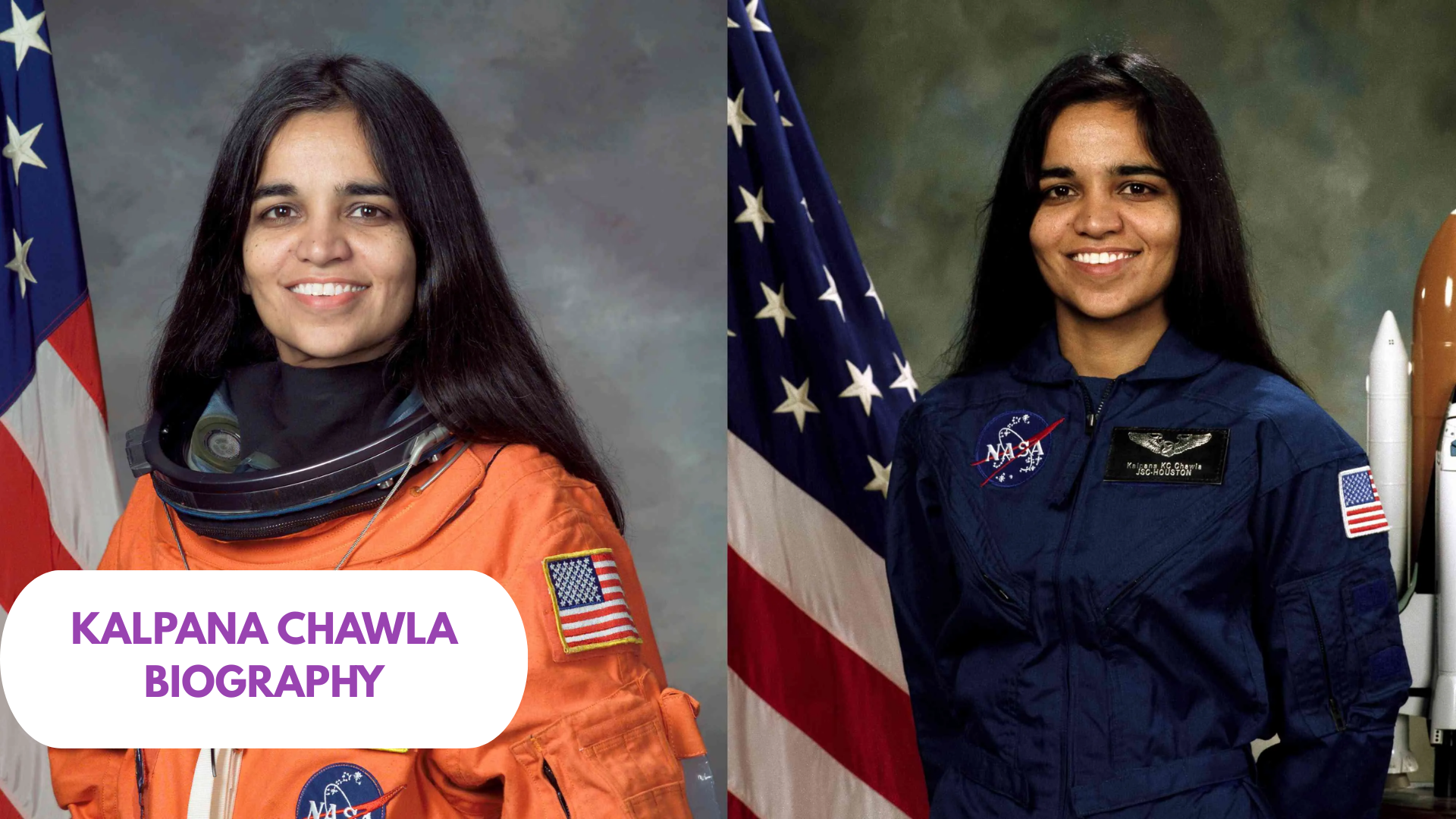
The story of Kalpana Chawla is one of courage, intelligence, determination, and dreams that transcended borders. As the first Indian-born woman to travel to space, she became a global icon of perseverance and scientific excellence.
Her life continues to inspire millions of young students, especially women, to pursue careers in science, technology, engineering, and mathematics (STEM).
Data
| Field | Details |
|---|---|
| Full Name | Kalpana Chawla |
| Born | March 17, 1962 |
| Age | 40 years (at the time of death in 2003) |
| Death | February 1, 2003 |
| Birthplace | Karnal, Haryana, India |
| Nationality | Indian-American |
| Occupation | Astronaut, Aerospace Engineer |
| Spouse | Jean-Pierre Harrison |
| Net Worth | Not publicly available |
Early Life
Kalpana Chawla was born on March 17, 1962, in Karnal, Haryana, India. From an early age, she showed deep curiosity about flying and space. As a child, she would watch airplanes flying over her hometown and dream of touching the skies one day.
Growing up in a traditional Indian family, Kalpana defied societal expectations by choosing aeronautical engineering — a field dominated by men at the time. Her parents supported her ambition, and she remained focused on achieving her dream of becoming an astronaut.
Education
Kalpana completed her early schooling in Karnal before pursuing higher education in engineering. She earned her Bachelor of Engineering degree in Aeronautical Engineering from Punjab Engineering College in Chandigarh.
Determined to gain advanced knowledge, she moved to the United States for further studies. She obtained a Master of Science degree in Aerospace Engineering from the University of Texas and later earned a Ph.D. in Aerospace Engineering from the University of Colorado.
Her academic excellence and deep passion for aerospace sciences laid the foundation for her future career at NASA.
Journey to NASA
Kalpana Chawla became a naturalized U.S. citizen and joined NASA’s Ames Research Center in 1988. Her research focused on computational fluid dynamics and vertical/short takeoff and landing concepts.
In 1994, she was selected as an astronaut candidate by NASA. After rigorous training, she officially became a NASA astronaut in 1995.
Her selection was historic. She became the first woman of Indian origin to be selected for a space mission.
First Space Mission – STS-87 (1997)
Kalpana Chawla made her first journey to space aboard the Space Shuttle Space Shuttle Columbia during mission STS-87 in November 1997.
During this mission:
- She served as a mission specialist.
- The crew conducted microgravity experiments.
- They studied the effects of space on various materials and biological samples.
She spent over 15 days in space and orbited Earth 252 times. This mission made her a national hero in India and a global inspiration.
Second Space Mission – STS-107 (2003)
In 2003, Kalpana Chawla embarked on her second space mission aboard Space Shuttle Columbia (STS-107).
This mission focused heavily on scientific research and experiments. The crew conducted nearly 80 experiments in microgravity, covering fields such as:
- Life sciences
- Physical sciences
- Fluid physics
- Combustion research
Kalpana once said:
“The path from dreams to success does exist. May you have the vision to find it, the courage to get onto it, and the perseverance to follow it.”
Her dedication to science was evident throughout the mission.
The Columbia Space Shuttle Tragedy
On February 1, 2003, tragedy struck. As Space Shuttle Columbia re-entered Earth’s atmosphere, it disintegrated due to damage sustained during launch.
All seven crew members aboard lost their lives, including Kalpana Chawla.
The Columbia disaster shocked the world. It was one of the darkest moments in NASA’s history. However, Kalpana’s courage and contributions ensured that her legacy would never fade.
Awards and Honors
Kalpana Chawla received numerous honors posthumously. Some of the major recognitions include:
- Congressional Space Medal of Honor
- NASA Space Flight Medal
- NASA Distinguished Service Medal
In India, several institutions and awards have been named in her honor. These include:
- Kalpana Chawla Government Medical College
- Kalpana Chawla Planetarium
- Scholarships for female engineering students
She became a symbol of women empowerment and scientific ambition.
Personal Life
Kalpana Chawla married Jean-Pierre Harrison, a flight instructor and aviation author. The couple shared a love for flying and aviation.
Despite living in the United States, Kalpana remained deeply connected to her Indian roots. She often spoke about her childhood in Karnal and encouraged Indian students to dream big.
FAQs
1. Who was Kalpana Chawla?
Kalpana Chawla was an Indian-American astronaut and the first Indian-born woman to travel to space.
2. When was Kalpana Chawla born?
She was born on March 17, 1962.
3. How did Kalpana Chawla die?
She died in the Columbia Space Shuttle disaster on February 1, 2003.
4. How many space missions did she complete?
She completed two space missions: STS-87 (1997) and STS-107 (2003).
5. What is Kalpana Chawla famous for?
She is famous for being the first Indian woman in space and for her contributions to aerospace research.
6. What degrees did she earn?
She earned a Bachelor’s in Aeronautical Engineering, a Master’s in Aerospace Engineering, and a Ph.D. in Aerospace Engineering.
Conclusion
The biography of Kalpana Chawla is not just the story of an astronaut — it is the story of a dreamer who dared to defy limits. From the streets of Karnal to the vastness of outer space, her journey reflects the power of ambition and resilience.
Although her life ended tragically, her legacy continues to shine brighter than the stars she once studied. Kalpana Chawla will forever remain a symbol of hope, determination, and excellence in space exploration.
Her message to the world is clear: Dream big. Work hard. Never give up.